Current Tools in POKY
POKY's "Automated assignment" and "Superfast assignment" menus run an Enhanced I-PINE and PINE-SPARKY.2 for automated backbone and sidechain resonance assignment, the Predict-and-Confirm method for superfast sidechain assignment, and the Versatile Assigner. The Enhanced I-PINE engine in POKY is more powerful than the original I-PINE webserver, giving higher assignment accuracy and coverage on the same peak lists. See the POKY Features page for the complete, current feature list, and the Command Reference for every assignment command.
The automatic assignment series at a glance:
| Tool | Assigns | Start it in POKY | Results |
|---|---|---|---|
| I-PINE (PINE-SPARKY.2), incl. M-PINE | Protein backbone and side chains, solution NMR (38 experiment types, incl. 13C-detected and MOCCA) | ep | Import with Check; job dashboard |
| I-ssPINE (ssPINE-POKY) | Protein backbone and side chains, solid-state NMR | EP | Import with Check; job dashboard |
| ARSIGN (ARSIGN-POKY) | Protein aromatic ring C–H (Phe, Tyr, Trp, His), up to 10 experiments | ar | Import with Check; job dashboard |
| RNA-PAIRS / IMINA | RNA imino H/N and base pairs from HSQC + NOESY | ER | IMINA job dashboard |
APES & iPick Automated Peak Picking
APES (accelerator ae) provides AI-assisted backbone peak picking directly inside POKY, reducing the manual thresholding work described in picking peaks. APES is the recommended starting point before running automated assignment, since assignment accuracy depends heavily on the completeness of the picked peak lists.
iPick (accelerator iP) is a complementary automated peak picker, providing more versatile and sophisticated peak picking for spectrum types beyond APES's backbone focus. iPick is also the integration point for REDEN's multi-fitting peak decomposition in crowded regions.
Enhanced I-PINE, PINE-SPARKY & PINE-SPARKY.2
PINE (Probabilistic Interaction Network of Evidence) is a server-based automated assignment engine; I-PINE is its improved iteration. POKY runs an Enhanced I-PINE that surpasses the original I-PINE server, delivering more accurate and more complete backbone and sidechain assignments from the same peak lists.
M-PINE: C13-detected and MOCCA-based experiments
For intrinsically disordered proteins (IDPs), where poor amide proton dispersion limits conventional 1H-detected experiments, Enhanced I-PINE includes the M-PINE module, which additionally supports 13C-detected experiments and MOCCA-based experiments (experiments 30–38 in the I-PINE experiment profile). These experiments use nitrogen and carbonyl carbons as the detected nucleus and provide sequential connectivity through C′ and N:
| # | Experiment | Correlations |
|---|---|---|
| 30 | CON | N(i) – C′(i−1) |
| 31 | NCON | N(i) – C′(i−1) – N(i−1) |
| 32 | NNCO |
N(i) – C′(i−1) – N(i−1) N(i) – C′(i−1) – N(i) N(i) – C′(i−1) – N(i+1) |
| 33 | CCCON | N(i) – C′(i−1) – CX(i−1) |
| 34 | HCCCON | N(i) – C′(i−1) – HX(i−1) |
| 35 | CONHA | C′(i−1) – N(i) – Hα(i−1) |
| 36 | NCOHA |
C′(i−1) – N(i) – Hα(i−1) C′(i−1) – N(i) – Hα(i) |
| 37 | CO-MOCCA-COHA |
Hα(i−1)–C′(i−1)–C′(i−1) (strongest) Hα(i−1)–C′(i−1)–C′(i−2) (mid) Hα(i−1)–C′(i−1)–C′(i) (mid) Hα(i−1)–C′(i−1)–C′(i−3) (weak) Hα(i−1)–C′(i−1)–C′(i+1) (weak) |
| 38 | N-MOCCA-COHA |
Hα(i−1)–C′(i−1)–N(i) (strongest) Hα(i−1)–C′(i−1)–N(i−1) (mid) Hα(i−1)–C′(i−1)–N(i+1) (mid) Hα(i−1)–C′(i−1)–N(i−2) (weak) Hα(i−1)–C′(i−1)–N(i+2) (weak) |
PINE-SPARKY
PINE-SPARKY (accelerator pp / pr / ab) is the original Sparky plugin built to verify probabilistic PINE assignments: it imports the backbone and sidechain assignments returned by the PINE server into Sparky and displays them as assignment probability tables and spin-graph-like diagnostics for visual review. See the PINE-SPARKY manual for details.
PINE-SPARKY.2
PINE-SPARKY.2 (accelerator ep) is the POKY-revised version of PINE-SPARKY, focused on the other half of the workflow: submission and import. It turns sending peak lists to the Enhanced I-PINE server and pulling the results back into your project into a few mouse clicks from the POKY interface, on top of the same probability-table review workflow. Enhanced I-PINE supports 38 solution-state NMR experiments — see the full I-PINE experiment profile. For solid-state NMR, ssPINE-POKY uses a separate set of ssNMR experiments listed in the ssPINE experiment profile. See the PINE-SPARKY.2 manual for the full submission and review workflow.
Every I-PINE job also has a job dashboard: the sequence coloured by assignment probability, secondary-structure predictions, LACS referencing, the simulated HSQC, a 3D view and all result files. A few minutes after the job finishes, the dashboard also shows a TAPAS prediction (torsion angles, secondary structure, RCI-S2, solvent accessibility) computed from the assigned shifts. Its link is in the e-mail sent when the job finishes, and the Web... button next to the Key field of the dialog opens it.
How reliable is Enhanced I-PINE?
On the same 106-protein real-data set that ARTINA reports on, the Enhanced I-PINE assignment engine, run the way the server runs it, grades 99.80 % correct on the backbone (9936 correct / 20 wrong at probability cutoff 0.99), with 92 of 104 gradable proteins fully correct.
Graded the way ARTINA grades (all atoms, 0.03 ppm 1H / 0.4 ppm 13C,15N tolerance), Enhanced I-PINE also exceeds ARTINA's published fractions on the same dataset: backbone 98.66 % vs 97.22 %, side-chain 93.48 % vs 88.04 %, and all-atom 94.79 % vs 91.36 %.
Two parts of the engine changed in October 2026. Spin systems are now scored against a backbone chemical-shift distribution rebuilt from the LACS-referenced BMRB/PDB data that TAPAS was trained on, which replaces the older static table. The per-residue chemical-shift prediction prior now comes from BP4 run on two predicted structures of your sequence (ESMFold and Boltz-2) and averaged, instead of UCBShift. On these proteins the averaged BP4 prediction is closer to the measured shifts than UCBShift for every backbone atom (N RMSE 1.98 vs 2.30 ppm). The figures above were measured without BP4's homolog transfer, because these proteins' own shifts are in BMRB. Without any prediction prior the engine grades 9887 / 26; with UCBShift 9939 / 23.
The assignment is also robust to spurious peaks: injecting 5–20 % false in-range peaks (the noise an automatic peak picker adds) into the input leaves the backbone assignment within 0–1 wrong residues and the all-atom fraction above 98 % on the tested proteins.
I-ssPINE (ssPINE-POKY)
ssPINE-POKY (accelerator EP, also in the solid-state menu) is the solid-state counterpart of PINE-SPARKY.2: it submits solid-state NMR peak lists of a protein to the I-ssPINE server and imports the probabilistic backbone and side-chain assignments with Check. The supported experiments are listed in the ssPINE experiment profile.
The I-ssPINE server now runs on POKY's Python ssPINE engine. Since October 2026 it uses a chemical-shift-prediction prior and a joint N/CA/C prior by default, and when a job fails the e-mail states the cause. Results come with a job dashboard (2D CaCb simulation, LACS for CA/CB/CO, probabilistic side-chain assignments), opened from the e-mail or the Web... button of the dialog.
PLUQin-POKY
PLUQin-POKY (accelerator pq) is the POKY module for PLUQin, an amino-acid type prediction extension built on the PACSY chemical shift statistics database. Given a residue's observed chemical shifts, PLUQin-POKY narrows down the likely amino acid types, helping confirm or rule out candidate assignments alongside I-PINE/PINE-SPARKY.2 and the Versatile Assigner.
PACSY and PLUQin-POKY were developed by Prof. Woonghee Lee. The PLUQin was developed by Dr. Keith Fritzsching, formerly of the Mei Hong group.
ARSIGN-POKY
ARSIGN is a dedicated automated assignment engine for aromatic sidechain resonances — the ring 13C–1H pairs of phenylalanine, tyrosine, tryptophan and histidine, which backbone assignment tools do not cover. ARSIGN-POKY (accelerator ar) is its POKY interface: add the aromatic spectra with Add, click Submit, and later click Check with the job ID in the Key field to import the results into your project. ARSIGN uses the backbone and Cβ/Hβ assignments already in your project as anchors, so run it after the backbone (for example with I-PINE) is assigned.
ARSIGN-POKY accepts peak lists from up to 10 aromatic NMR experiments — see the full ARSIGN experiment profile for the complete list. The supported experiment types include:
- 2D C-HSQC — aromatic ring CH one-bond pairs
- 2D CBHD / CBHDHE — relay from backbone CB to ring δ and ε protons
- 3D CBCDHD / CBCEHE — relay through ring carbons to δ/ε protons
- 3D CCH-TOCSY / HCCH-TOCSY — aromatic ring TOCSY correlations
- 3D aroC-NOESY — aromatic-carbon-detected NOESY
- 3D aliC-NOESY — aliphatic-to-aromatic NOEs
- 3D N-NOESY — backbone amide NH to aromatic proton NOEs
Not every experiment is required: the aromatic C-HSQC plus any of the others works, and ARSIGN also runs from NOESY spectra alone (with more conservative confidence settings).
How ARSIGN assigns
ARSIGN is probabilistic. For every candidate assignment it predicts the cross-peaks each submitted experiment should show and scores them against the local peak density of that spectrum; how often each kind of cross-peak is actually observed is estimated from your own data. Phe/Tyr ring flips (equivalent δ1/δ2 and ε1/ε2) are modelled explicitly, and all rings are assigned together so that no peak is used twice. A ring proton whose C-HSQC peak is missing or overlapped can still be placed from the other spectra, so it does not take another residue's peak.
Spectra do not have to be referenced identically. ARSIGN measures a referencing offset for every axis of every peak list against the aromatic C-HSQC and your backbone/Cβ assignments and corrects it automatically (offsets of up to about 1 ppm 13C/15N and 0.1 ppm 1H are handled), and it learns a separate matching tolerance for each axis of each experiment, so a noisier spectrum does not loosen the matching of the others.
With Use computed structure model checked (the default), the server predicts the structure of your sequence (Boltz-2) and its ring chemical shifts (SHIFTX2) and uses them as residue-specific expectations; previously predicted sequences are served from a cache.
Every assignment carries a calibrated probability. When the best assignment of a peak is not confident enough, ARSIGN abstains: it reports NO ASSIGNMENT with its best guess as the second choice. The probabilities are calibrated per experiment set (a regime-aware feature model rather than a single global map), so sparse and NOESY-only spectra are no longer over-confident; the expected calibration error is about 0.01. On a 9-protein benchmark (272 aromatic C-HSQC peaks) 96% of peaks are assigned correctly, 96% of the committed assignments are correct, and the correct answer is among the top five choices for every peak; on 60 further proteins simulated from BMRB shifts and their structures (2,156 peaks) 97% of peaks are assigned correctly and 98% of the committed assignments are correct. With a quarter of all peaks removed, 91% (simulated set) and 80% (benchmark set) of the remaining C-HSQC peaks are still assigned correctly.
Results: arsign_roots.txt (ranked choices for every C-HSQC peak),
aromatic_sidechain_table.txt, sidechain_table_all.txt,
arsign_resonance.list (assigned ring shifts), arsign_v2.json
(machine-readable probabilities and diagnostics) and sim_aroCHSQC.pdf
(simulated aromatic C-HSQC with the assignments).
ARSIGN results dashboard
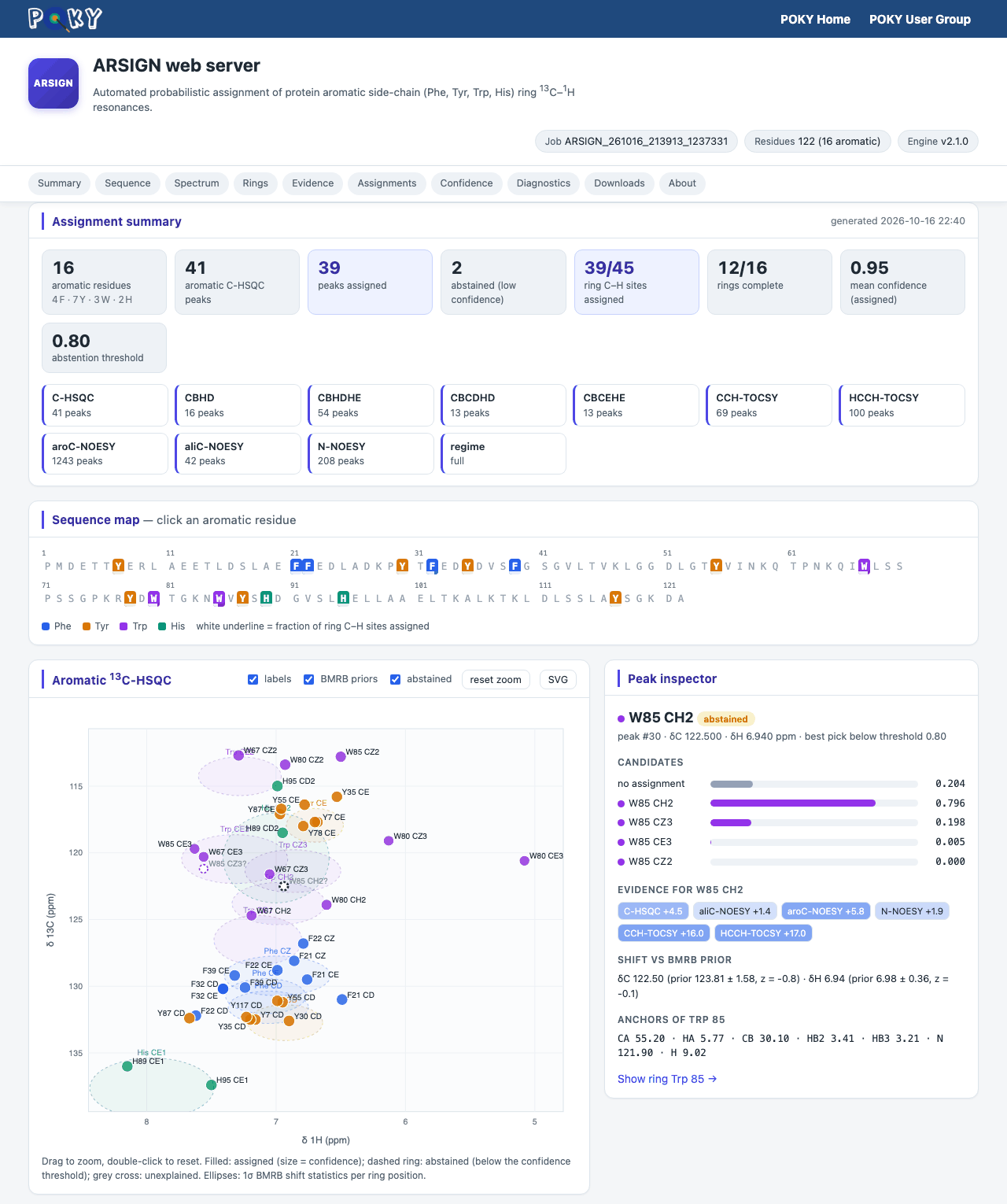
Every ARSIGN job now also has an interactive job dashboard.
The e-mails sent when the job starts and when it finishes contain its link:
https://poky.clas.ucdenver.edu/serverside/results/<JOB>/web_results/index.html.
It shows the interactive aromatic C-HSQC, a ring diagram for every aromatic residue, the evidence from
each experiment behind every assignment, the confidence of each peak and a list of peaks and rings to
check by hand.
RNA-PAIRS / IMINA (RNA imino assignment)
RNA-PAIRS (accelerator ER, "Automated Imino Assignments") assigns the imino 1H/15N signals of RNA and the base pairs they report. In the dialog, give the sequence/secondary-structure file, a 2D imino 1H,15N HSQC (or HMQC) and a 2D 1H,1H NOESY, then submit.
RNA-PAIRS jobs are now processed by IMINA (Imino Model-guided NMR Assignment), the
Python successor of RNA-PAIRS. IMINA combines the HSQC and NOESY peak lists with predicted and
experimental secondary structure in a probabilistic factor graph, uses a predicted 3D structure of the RNA
as a structural scaffold, and returns the probabilistic HSQC assignment
(hsqc_probabilistic_assignment.txt), the secondary structure
(secondary_structure_output.txt, secondary_structure_probabilistic_output.txt)
and an interactive IMINA job dashboard — nucleotide map, imino
HSQC with assignments, base-pair arc plot, 3D structure and tables. The link is in the e-mail sent when
the job finishes.
BMRB Reference Views
BMRB Reference Views compares an experimental spectral slice against standard chemical shift ranges statistically derived from chemical shifts deposited in the BMRB (Biological Magnetic Resonance Bank), letting you cross-validate signal positions against chemical shift probability ranges in real time.
For proteins, the accelerator ir opens up to three interactive windows — a CA-CB window, an all-carbon window, and an all-hydrogen window — each comparing experimental peaks against the 2D chemical shift probability density maps for all 20 amino acids. For RNA, the accelerator IR provides the analogous nucleotide-based reference views, built from BMRB chemical shift statistics for the four RNA nucleotide types.
Versatile Assigner
The Versatile Assigner (accelerator va) extends assignment-guessing (see guessing assignments) with a more general, project-wide search across multiple spectra and constraint types, useful for sidechain and NOE assignment once the backbone has been established by I-PINE/PINE-SPARKY.2.